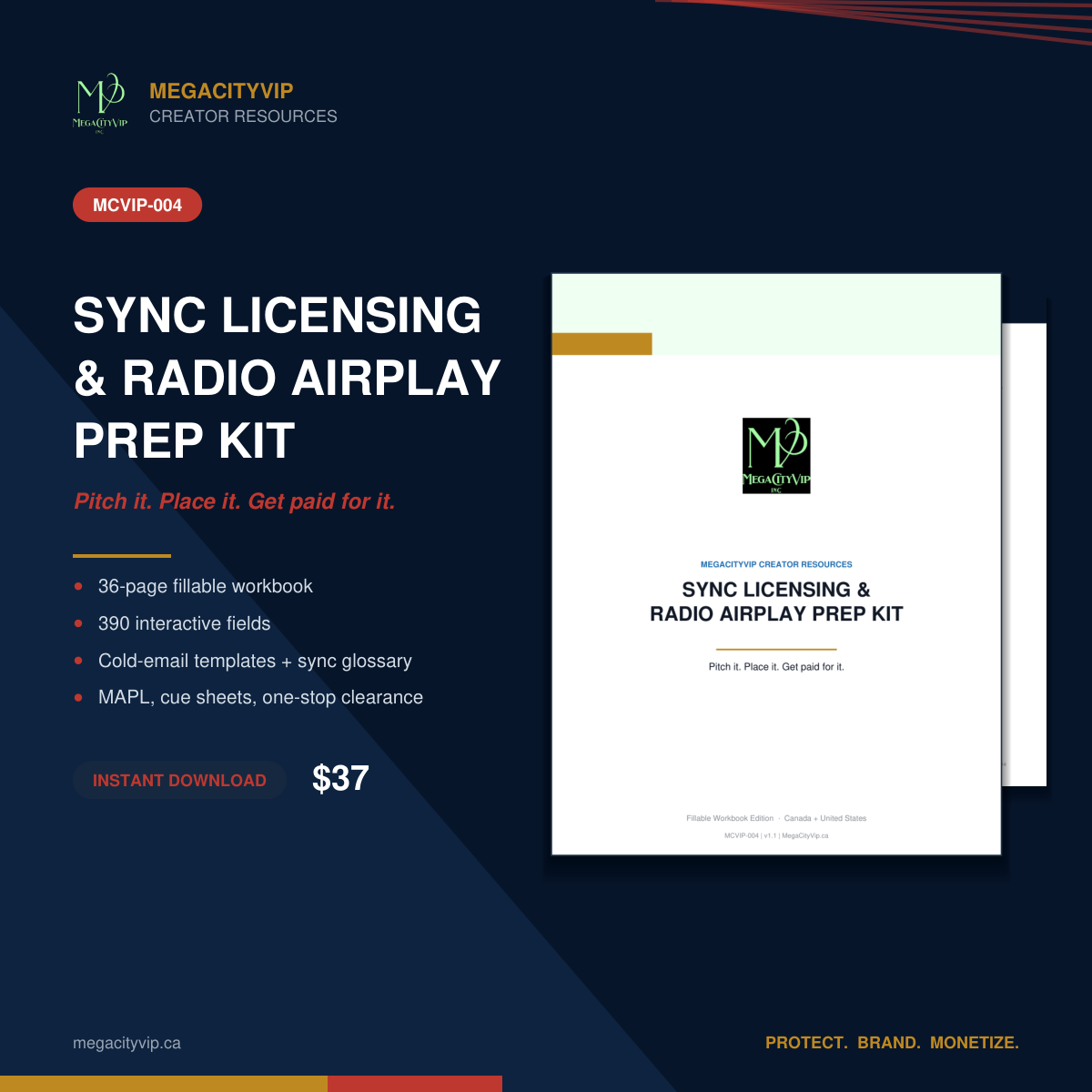
Get your catalogue into the shape music supervisors and radio programmers actually
expect — before you pitch anyone. A 36-page fillable workbook covering sync
submission, radio airplay, MAPL and Canadian content, one-stop clearance, cue
sheets, and the deal terms that decide what you keep. Canada + United States.
Instant download. (Introductory price $37, rising to $47 on September 1st, 2026)
Description
Most independent artists don’t get passed over because the song wasn’t good enough.
They get passed over because the paperwork wasn’t ready.
A music supervisor working to a deadline needs to know three things in the first ten
seconds: what the track is, whether you can clear it, and whether the versions they
need already exist. If the answer to any of those is “let me check,” they move to the
next song. A radio programmer is making a similar call, on similar volume, with
similar patience.
This workbook gets you ready for that moment.
What’s inside
- Radio, charts & sync 101 — corrected for 2026. BDS was retired in 2022;
Luminate and Mediabase handle airplay tracking now. Most guides still get this
wrong, and it’s an easy way to look uninformed in a pitch. - The Canadian layer no U.S. guide covers. MAPL and Canadian content
requirements, the campus and community radio lane that actually charts nationally,
and why a Canadian broadcast play is worth more to a performer than an American one. - One-stop clearance — what it means, why it decides deals between two equally
good songs, and exactly what to do if you aren’t one-stop yet. - Asset delivery spec — instrumental, TV mix, a cappella, clean edit, and the
:15/:30/:60 cuts advertising actually works in, plus a file-naming convention. - Cue sheets and getting paid — the single most expensive omission in most
artists’ sync knowledge. You can win a placement, get the fee, watch it air, and
never see a performance royalty, because nobody filed one document. - Deal terms and red flags — term, territory, exclusivity, backend, reversion,
and the AI training carve-out to demand in every agreement you sign in 2026. - How to vet a sync company — six questions and five business models, so you can
assess any company yourself. When this edition was verified, two of the most widely
recommended names in the industry were closed to unsolicited submissions and still
being listed as open by guides published this year. - The Pro Appendix — three cold-email templates (direct to supervisor, to a
library, and the single follow-up), a full sync licensing glossary, and the
CASL / CAN-SPAM basics so your outreach is compliant by default.
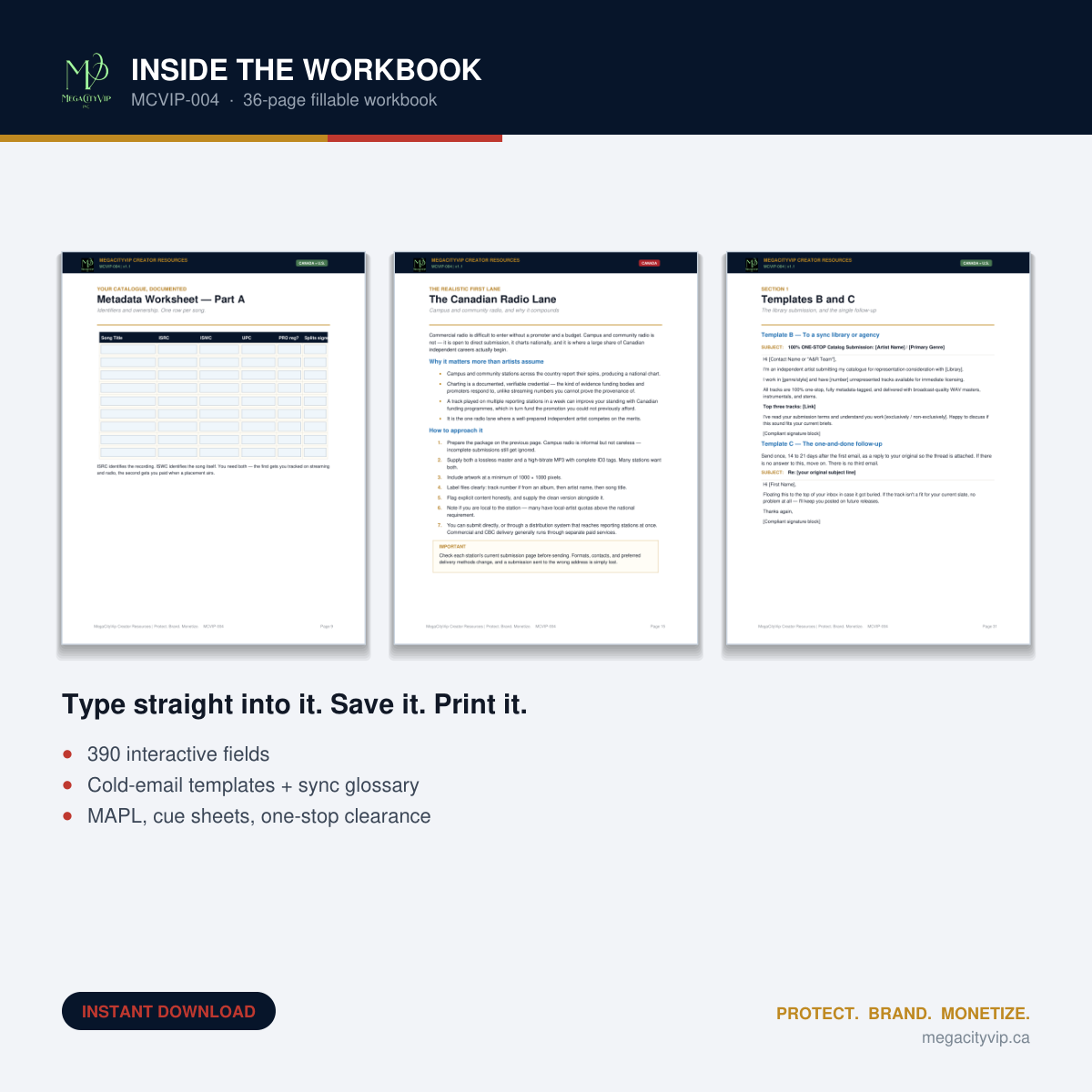
Worksheets you fill in
Metadata & catalogue readiness (two parts) · MAPL designation · radio one-sheet ·
sync readiness · submission tracker (two parts). 390 interactive fields.
File details
- 36-page fillable PDF · 390 form fields · instant download
- Type directly into it, save it, print it, or reuse it release after release
- Works in Adobe Acrobat Reader, Apple Preview, and any PDF reader supporting forms
- Canada + United States, with every page marked CA, US, or both
- All facts verified August 2026 and date-stamped in the file
What this kit is not
It doesn’t submit music for you, and it can’t guarantee airplay, chart placement, or
a sync deal — those are curatorial decisions made by people. It makes sure that when
you reach those people, nothing about your catalogue gives them a reason to say no.
Educational information only. Not legal, financial, or business advice.
Digital download — please read before purchasing. Because this is an instant
download delivered immediately at checkout, all sales are final and we do not offer
refunds once the file has been downloaded. Every product page lists the exact page
count, field count, and contents so you know precisely what you are buying. If your
download link fails, contact us and we will resend it.